Moby-Dick as a nuclear-war allegory
The WhaleMoby-Dick as a nuclear-war allegory is not a single fixed interpretation but a series of political re-readings that make Herman Melville’s whale and ship newly legible in the atomic age. In the late 1940s, Gilbert Wilson saw Moby Dick as an augury of nuclear conflict; later critics connected the whale’s appearances to atomic detonations, and C. L. R. James recast the Pequod as a weapon of mass destruction. These readings turn the novel’s pursuit into a warning about the danger of meeting power with ever greater power—and about how readily a myth can be recruited by opposing political causes.
From sea wilderness to atomic theater
The allegory gains force from the sea’s double character. It is a world-spanning wilderness, older than the cities and civilizations built along its shores, yet also a space people mistake for a mere distance to cross or a domain they have mastered. Its changing surface can conceal what moves beneath it; its apparent calm does not mean that its depths are knowable or controlled. Read against this oceanic scale, the nuclear age does not simply replace the whale’s old setting with a modern one. It makes the sea a theater where human claims to mastery confront forces that exceed them.
The book’s wider marine perspective also sets political violence against forms of life operating on different scales of time. Humpbacks return each summer to the Gulf of Maine after a migration of up to eight thousand miles, following inherited routes and ocean currents that gather food from the deep. That recurring journey is not presented as an allegory of nuclear politics, but it sharpens the contrast: the ocean sustains vast patterns of life even as human beings imagine it as a stage for domination. In the atomic readings, the whale’s presence unsettles the idea that the sea, or the world, can be reduced to a territory under human command.
The whale as an omen
In the late 1940s, the American artist Gilbert Wilson became absorbed both in Melville’s novel and in modern science. He argued that the novel powerfully exposed the fatal consequences of hatred and domination, and proposed to Dmitri Shostakovich an opera based on Moby-Dick as a means of easing Cold War discord between the United States and the Soviet Union and helping restore peace. For Wilson, the book was not merely a story to adapt: it might intervene in a crisis by making the logic of destructive antagonism visible.
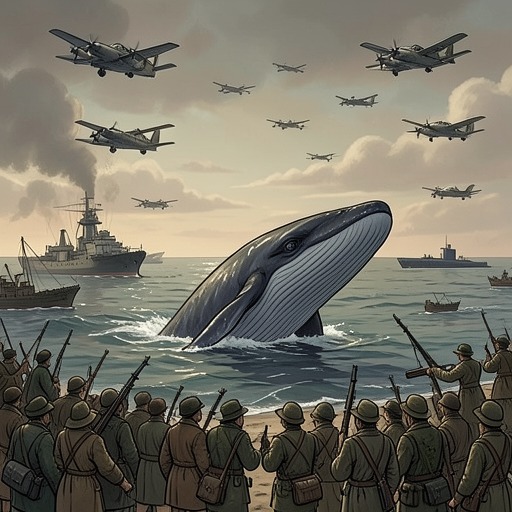
Wilson’s darker reading made Moby Dick an omen of atomic conflict. He compared Ahab’s obsessive pursuit into the Sea of Japan with American nuclear experiments and explosions in the same region. The whale’s appearance could therefore be read not only as a threat within the novel but as a figure for violence already unfolding in modern history. A brief image of a cloud resembling a whale compresses that transformation: the familiar outline of a living creature appears in the atmosphere, where a reader of the atomic era could see the shadow of an explosion. The image does not settle the whale’s meaning; it shows how readily the novel’s myth can attach itself to a new and frightening reality.
Howard P. Vincent’s 1949 study, The Trying-Out of Moby-Dick, made this portability explicit. He treated Moby Dick as a presence able to recur across different times and places: the whale that sank the Pequod could also be imagined breaching in the years after the war, over a New Mexico desert, Hiroshima and Nagasaki, and Bikini Atoll. This is not a literal claim that the whale appears there. It is a critical figure for connecting Melville’s fiction to nuclear sites, making the novel’s old catastrophe seem to return in the present.
The Pequod as American power
Earlier, writing in Lobo, New Mexico, D. H. Lawrence had already read the Pequod as the vessel of the white American soul and the novel as a premonition of the destruction of the American era. The nuclear interpretations intensify that national reading: the ship is no longer only a whaling vessel on a dangerous voyage, but a vehicle for a collective political identity whose pursuit may carry it toward ruin.
In 1952, C. L. R. James wrote his critique of Moby-Dick while detained on Ellis Island, within sight of Manhattan’s towers and in a brick building beside Liberty Island. His circumstances placed his reading close to the symbols of American power, while his essay compared Ahab with modern dictators. James emphasized the Pequod’s technological and navigational capacities: Ahab commands an advanced vessel and the accumulated scientific knowledge needed to guide it. Those capacities make him more dangerous, not more restrained. The ship’s practical mastery of navigation becomes part of the threat, and the whaling vessel can be understood as a weapon of mass destruction. In this reading, the catastrophe follows not from a lack of knowledge but from knowledge yoked to an unchecked leader and a destructive objective.
A reusable political myth
The allegory did not remain the property of one political position. Around twenty years after James’s essay, members of the anti-capitalist Baader-Meinhof gang, imprisoned for their own campaign against imperialism, adopted code names from Moby-Dick; Andreas Baader took the name Ahab. They treated the monster of Melville’s myth, like the state imagined by Thomas Hobbes, as an adversary. The reversal is revealing: a story interpreted as a warning about Ahab’s destructive pursuit could also supply names to people pursuing a war of their own.
Ahab’s pursuit has continued to serve political satire, including comparisons between the captain and world leaders during the war on terror. The allegory’s endurance lies partly in this instability. Moby Dick can signify the catastrophe a power fears, while Ahab can be made to stand for an enemy—or for the power that pursues one. Read alongside the sea’s immensity and the life it sustains, these shifting identifications preserve the novel’s central warning: the drive to dominate what cannot be mastered may turn the pursuer’s own instruments of power into agents of destruction.